
Reading poetry in bed
it's better than a gummy

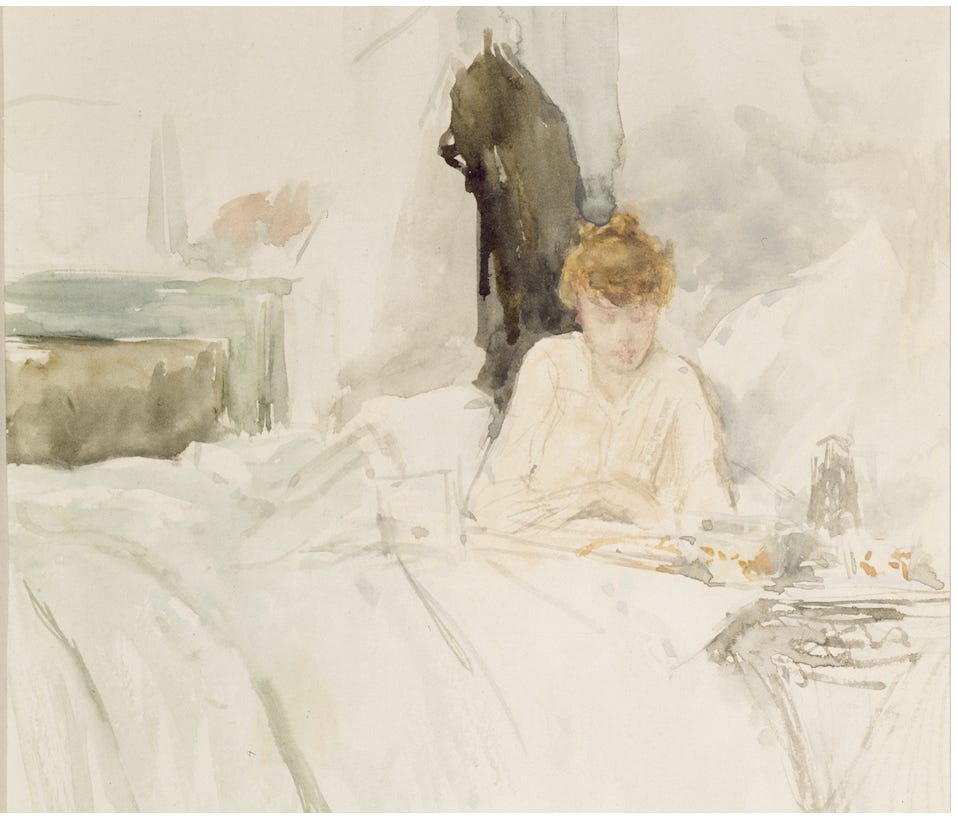
I have always loved poetry.
When I was a child, my father read his favorite poems to me. I still feel badly for Bess, the landlord’s red-lipped daughter, whose sad fate is rendered in the galloping lines of Alfred Noyes’ The Highwayman. I can still recite the self-satisfied stanza of A. A. Milne’s Now We Are Six. I read my kids Jack Prelutsky’s The Dragons Are Singing Tonight and Ogden Nash’s hilarious Custard the Dragon, which, thankfully, they loved.
In college, thanks to the marvelous anthology The Voice That Is Great Within Us, I read, again and again, works by Wallace Stevens, Kenneth Patchen, Langston Hughes, Denise Levertov and other American twentieth-century poets. Ten years ago, I discovered the fabulous (and worth supporting) blog, Read A Little Poetry, through which I have discovered countless other poems.
Lately, poetry has been my go-to read right before I fall asleep. I am working my way through one of the few comprehensive poetry anthologies available to read digitally, The Seashell Anthology of Great Poetry. The collection, unusually, is organized by theme so that poems from different centuries are mixed together. Thus, in the first section, Creation, I encountered my new favorite William Carlos Williams’ poem, The Artist, as well as the still subversive Emily Dickinson work, God is indeed a jealous God.
Reading poetry as a soporific works because, even when it is the angriest, poetry is soothing in some way. Even when it showcases anger like Mary Oliver’s Rage or deep sadness like Edgar Allan Poe’s Annabel Lee, it’s still somehow easier to take in than literature’s longer works. It also doesn’t make my brain churn in the way fiction does—late at night a poem falls into my head like a gift and then it’s gone, leaving only a feeling of faint joy.
The Seashell collection begins with To the Reader, by Denise Levertov, written in the august year of my birth.
As you read, a white bear leisurely
pees, dyeing the snow
saffron,
and as you read, many gods
lie among lianas: eyes of obsidian
are watching the generations of leaves,
and as you read
the sea is turning its dark pages,
turning
its dark pages.
The word pees makes the poem modern and yet it reads as something Blake might have penned. It’s a banger.
I discovered this poem a few years ago, something Facebook reminded me of yesterday.
Emily Dickinson at the Poetry Slam by Dan Vera (2008)
I will tell you why she rarely ventured from her house.
It happened like this:
One day she took the train to Boston,
made her way to the darkened room,
put her name down in cursive script
and waited her turn.
When they read her name aloud
she made her way to the stage
straightened the papers in her hands —
pages and envelopes, the backs of grocery bills,
she closed her eyes for a minute,
took a breath,
and began.
From her mouth perfect words exploded,
intact formulas of light and darkness.
She dared to rhyme with words like cochineal
and described the skies like diadem.
Obscurely worded incantations filled the room
with an alchemy that made the very molecules quake.
The solitary words she handled
in her upstairs room with keen precision
came rumbling out to make the electric lights flicker.
40 members of the audience
were treated for hypertension.
20 year old dark haired beauties found their heads
had turned a Moses White.
Her second poem erased the memory of every cellphone
in the nightclub,
and by the fourth line of the sixth verse
the grandmother in the upstairs apartment
had been cured of her rheumatism.
The papers reported the power outages.
The area hospitals taxed their emergency generators
and sirens were heard to wail through the night.
Quietly she made her way to the exit,
walked to the terminal and rode back to Amherst.
She never left her room again
and never read such syllables aloud.
So if you can’t sleep, consider poetry. In fact, consider poetry for many of life’s woes. It will, literally, free your mind and, as they say, the rest will follow.